

Listen to this article. [9:24]
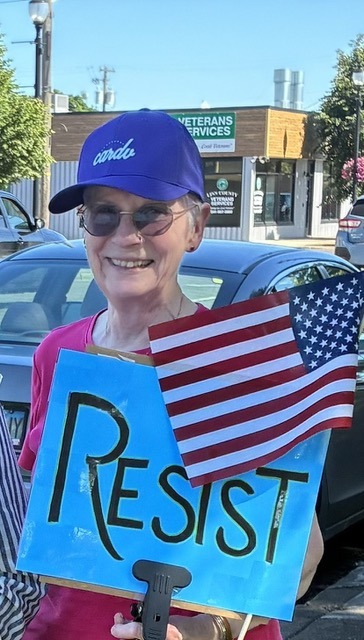
We stand here to remind everyone that what the current U.S. government is doing is wrong. To keep the issues visible. We’d like to think we’ll change some minds, but realistically, we know we probably won’t. It’s our dissent that matters. And it helps us feel as if we are doing something. At the very least, we will encourage those who are like-minded to carry on.
There’s something enormously moving to me—beautiful even—about all these people from different walks of life, coming together every Friday afternoon to nonviolently stand for what they believe. Most of us are gray heads. Some of us have been protesting one injustice or another since the 1960s. Some of us can’t stand very long anymore and sit on camp chairs. One woman holds on to her walker with one hand and her sign with the other. There’s a core group of six from the retirement village where I live who come every Friday. During larger protests, I recognize a lot more people from that community.
I never imagined I’d be out here as I was nearing eighty, fighting for things I had always thought were fundamentals in our country—including Social Security, Medicare, and Medicaid. During Donald Trump’s first presidency, we spent several weekends standing in front of the post office protesting cuts. Now we are defending basic democracy. How does it happen that fighting to uphold the Constitution is revolutionary?
The day Trump was sworn in for his second term, I started a list, “What Trump Did.” Things were happening so fast, I didn’t want to let the horror of one thing get overshadowed by the horror of the next. When I wrote this essay, my list was two pages long, single-spaced, 12-point font; he’d been in the White House less than four months.
Albany, Oregon, where I live, is a purple town in a red county in a barely blue state. It does not escape me that the driver of one of the cars or pickups driving by on Honk and Wave day could suddenly ram his (face it, it would probably be a guy) vehicle into as many of us as he can.
A guy driving a big black pickup rigged his diesel engine to blast a huge cloud of black smoke from the exhaust. One of the protesters said it’s called “rolling coal” and is illegal. He usually drives by at least once every Friday, blasting this cloud. Sometimes twice. Last week one of my group caught it particularly hard and coughed all week.
Still, there are a lot more honks and waves and fewer third fingers than during Trump’s first term. I’d like to think this means progress, but then again, he was reelected.
After the 2016 election, I put a black bumper sticker on my car that said simply RESIST. As I was driving across Idaho after a trip to Colorado, a car traveling in the lane next to me held the same speed I was going for longer than was comfortable. There were just the two of us on the highway at that point. I had already been flipped off a few times that day (presumably because of the bumper sticker) and was feeling a little vulnerable. Finally, I glanced over at the driver. A woman met my eyes, put her hand over her heart and mouthed the words “Thank you!” before speeding away.
My sign during one Honk and Wave said SAVE SOCIAL SECURITY. An angry-looking young man slowed down, made eye contact with me, then gave me the finger. I flashed the peace sign at him. What, I thought—you don’t want your grandmother to get Social Security?
During the 2020 election, I was a volunteer observer at the elections office. One night I chatted with my co-observer, a Republican. We were in a small room watching volunteers counting ballots in the next room on closed-circuit TV screens. It turned out she had been a supporter of the agency where I work—the Center Against Rape and Domestic Violence—back in the early 1980s. I was a volunteer then, and we determined our paths had crossed. It was fun comparing our memories, and I realized I liked this Republican woman and could be friends with her. That was a nice feeling.
Then the conversation veered off to how divided the country was. “They [meaning Democrats] vandalized the American flag I had in front of my house!”
“But that’s our flag too!” I said, confused by her accusation and upset that the flag had been vandalized.
She stared at me, stunned. It was clear she had forgotten the American flag belonged to all of us—even the Democrats. She turned away from me and didn’t speak for the rest of our shift.
I have a small American flag that I got at the craft store attached to the top of my sign. This is my flag too.
I keep trying to think of a perfect combination of three or four words that will resonate with even the staunchest Trump supporter. But of course there isn’t any such thing. My favorite signs say things like, “Can girls have 30 dolls if Qatar gifts them?” and “GOP Health Plan—We are all going to die! (Senator Joni Ernst),” and “Now they’ve pissed off Granny!”
But drivers don’t read the signs. They have just enough time to grasp the overall message of the protest.
When we started the Friday afternoon Honk and Waves, my sign said SAVE MEDICADE. My friend Nancy pointed out that Medicaid was spelled wrong. At one time, I would have been embarrassed, but at this stage in my life, I just shrugged my shoulders. That night I scrunched an “I” between the “A” and the “D.” The next Friday, Nancy pointed out there wasn’t an “E” on the end. Good Grief! I know how to spell Medicaid! But for some reason, when I write letters really large on white boards or protest signs, the words look different and I forget how to spell. Now I do my signs in pencil and look at them very carefully before writing over the letters with magic markers.
My current sign is DEMOCRACY – NOT – DICTATORSHIP.
I’ve heard that tyranny can be overthrown if a significant percentage of the population can be mobilized into nonviolent resistance. The magic number seems to be 3.5 percent. This gives me hope and a sense of purpose. On Friday afternoons when I’m tired from a hard week and just want to collapse on my couch, I can get motivated to join the Honk and Wave by reminding myself that my body is needed for the count.
I used to be chronically idealistic. I was able to find the goodness in a person no matter how much muck I had to dig though, or how slight that goodness was. And I could speak to that place. This served me well when I worked at a manufactured-housing factory, and I forged bonds with a lot of men you would have thought were impossible.
I’ve lost that. I just haven’t been able to slog through the dogma of a Trump supporter to reach that kernel of goodness that I know is in everyone. And in spite of my two-page single-spaced list of “What Trump Did,” I grieve this the most.
It’s hard not to feel hopeless. So much is stacked against us. There are too many years of Trump’s presidency left. Will anything be left of our democracy when he’s done with it? What if we can’t come back from all this damage? Will I still be alive to see it if we can? Sometimes it’s only thoughts of the Friday Honk and Wave that keep me from crumbling into despair. Smiling, waving at traffic, yelling “Woohoo!” when cars honk in support. For those precious few moments I can feel powerful again.
Author's Comment
When my “What Trump Did” list passed the third page mark, I stopped adding to it. I simply could not bear scrolling through all his offenses any longer. As the months have worn on at the Honk and Wave, I’ve noticed there are a lot more cars and trucks waving and giving us a thumbs up, and fewer third fingers. This, I can only hope, is a good sign.
 A struggling woman is admitted to a prestigious Chicago hospital seeking help for her compulsions. Instead, her unethical psychiatrist ignores her actual problem and "treats" her as a victim of satanic ritual abuse. He uses powerful drugs and discredited forms of therapy to convince her she spent years in a cult where she sacrificed babies and committed other heinous acts.
Every page of Weaver’s riveting memoir shows how she struggled to maintain her sanity through one terrifying experience after another.
Learn more about the book and its author at jamielynweaver.com
Available from Amazon, Bookshop, Barnes and Noble, or ask for it at your local independent bookseller.
A struggling woman is admitted to a prestigious Chicago hospital seeking help for her compulsions. Instead, her unethical psychiatrist ignores her actual problem and "treats" her as a victim of satanic ritual abuse. He uses powerful drugs and discredited forms of therapy to convince her she spent years in a cult where she sacrificed babies and committed other heinous acts.
Every page of Weaver’s riveting memoir shows how she struggled to maintain her sanity through one terrifying experience after another.
Learn more about the book and its author at jamielynweaver.com
Available from Amazon, Bookshop, Barnes and Noble, or ask for it at your local independent bookseller.
 Mary Zelinka lives in Oregon's Willamette Valley and has worked at the Center Against Rape and Domestic Violence for over 35 years. Her writing has appeared in Persimmon Tree, The Sun Magazine, Brevity, and others.