

The Creative Spark: Introduction
Persimmon Tree being a medium largely for the written word, “The Creative Spark” prompted most of the submitters to describe becoming a writer, or returning to writing, rather than being drawn to another art. Yet even those reflections were remarkably varied, proving how that spark can grow, thrive, recede, or be reborn at any age.
In “Daydreams,” Enid Jones tells of growing up on a Caribbean Island where a teacher’s request for an essay on “A Day at the Beach” pushed her to write something beyond the mundane. A prolific reader, Lisa Trudel, in “When I First Realized My Creative Spark,” understands as a child that she could be an author too. Stephanie Shafran, in “My Creative Spark: A Flash of Survival,” learns as an adult that writing can help overcome apathy and depression. “How I Learned to Write,” by Suzanna de Baca shows how being in nature transforms into words.
To my delight, this issue’s topic also prompted submissions about the inspiration to play music, to draw and paint, to sew, and even to become a clown–Beth MacLeod’s “I Joined the Circus at 70” is an eye opener. In “For the Creative Spark,” Susan Anthony-Tolbert describes hating piano lessons until her father finds a humorous and inventive way for her to reconsider her decision. Sharon Brandon’s “The Creative Spark” shows how the comments of a discouraging childhood teacher can be dismissed by a breakthrough in her later years.
So many of these submissions resonated with me. I am a writer who was touched by the creative spark in second grade. I read a lot of books and realized that if others could be writers, I could too. My first “novella”: “Bobby Takes a Trip.” In eighth grade I won first place for a short story in the Scholastic writing contest. I started reviewing fiction for the Washington Post and the New York Times in my twenties. I won a PEN Syndicated Fiction prize for a short story in my thirties. Unlike many of the authors who submitted, I never had a period when I didn’t write. I wrote and edited books for grown-ups at the Library of Congress for fifteen years. In my late forties I discovered something I hadn’t expected: I loved writing for a young audience. I have since written several successful books on American history for middle school and young adult readers.
So many of us touched by the creative spark were encouraged by teachers, family, and friends. “You write (or draw, or play) really well” are magic words to any aspiring artist. So I want to end this introduction by thanking all the people who have supported our work, guided us, and accepted that there are some times where everything else has to be put aside because the calling is so great.

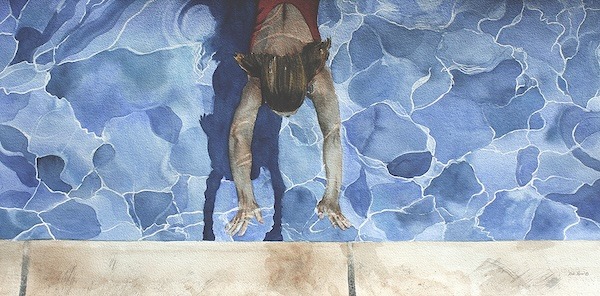
First In, watercolor from the “Immersion” series by Kate Peper
Smith Corona Typewriter
“Freddy the Eraser,” my earliest writing attempt, won first place for my grade in an elementary school essay competition during Fire Prevention Week. Freddy was not your ordinary eraser; he had the ability to extinguish fires. At the school assembly, lined up on stage with several others who won for their grade, I excitedly hugged my prize—a Frankie Lymon 78 RPM vinyl record. “Why I Love Canarsie” (my hometown in Brooklyn, New York), written in seventh grade, awarded me a runner-up title sponsored by the local newspaper, The Canarsie Courier. My photo and article were in the paper, and my award was a transistor radio. This inspired me, years later as a teenager, to start my own local newspaper called “The Canarsie Gazette.” Decades later, in Seattle, I shared a newspaper column with other contributors.
Following my early newspaper fame, my world crashed. At age thirteen, a huge growth spurt revealed a significant curvature of my spine. Due to severe scoliosis and barbaric treatment options in the 1960s, I was admitted into a foreboding building called, “House of St. Giles, Home for the Cripple.” Truly. Surgically, a piece of my hip was fused to my lower back to straighten the spine as much as possible. Wrapped in a body cast and confined to being flat in bed for six months was my punishment. Not sure for what.
During my healing, my Language Arts teacher gave me a journal. He thought of me as a good writer and stated this would be a good opportunity to express my feelings. But, writing about it made it too real. I preferred disassociating.
At the end of my sentence, my cast came off—and was replaced by a monstrous protruding steel back brace. At least I could walk.
When I arrived home—on my own two feet, with my parents on either side to hold me up after I’d been bedridden for so long—my grandmother and younger brother greeted me. Walking in, I spotted a huge brown case on the kitchen table. My illiterate immigrant grandmother, half paralyzed from several strokes, smiled her crooked smile. “Open it, Ellen Coo,” she murmured.
Inside I found a brand-new Smith Corona manual typewriter. Forgetting how unsteady I felt, I galloped down the hall to find a sheet of plain white paper. Unlike the sticky keys in typing class, with half of them not working, the Smith Corona’s were perfect. I later found out my grandmother saved the miniscule amount of money she received from welfare assistance to purchase it.
My creative spark caught fire. No need for Freddy the Eraser to extinguish it. I created one teenage angst story after another using carbon paper—and Wite-out for my many typing errors. I never stopped.
That typewriter, my most treasured possession from my most treasured person, is stored in the attic to be passed down to my grandchildren. Although my grandmother couldn’t read or write one single word, she loved to listen to mine.

Daydreams
The joyous cock-a-doodle-doo of the rooster from a house further down my street was my alarm clock at just before 6 a.m. each morning, rain or shine. Yes, the rooster kept its clock going to announce the morning on this tropical island. As a nine-year-old girl, whenever I heard the rooster, I tried to lie in and daydream for a few minutes before jumping out of bed to explore. That is when I knew I wanted to be a writer. My imagination ran wildly in that time between sleeping and activity.
During the day I would daydream about all events described in the words of the songs on the radio, but more so about the characters in the news and stories read by BBC announcers about faraway places in the British Commonwealth. My island was like the center of the world, absorbing information from countries in the commonwealth through music, radio soap operas, descriptions of dance moves, and classic literature exported from these countries into my little home in the Caribbean Sea. I absorbed it all like a sponge soaking up water. I would disappear to the top of a tree where I would read, dream, and weave my stories.
At age ten I entered high school, a combination of middle and high with classes geographically separated into lower, middle, and upper forms, British style. Students collaborated between levels through groupings called houses, defined by the color of the house. As a 10-year-old first former, I imagined how I would do my best work so that, when I reached a higher form, I could be chosen to lead a house. I saw my chance the very second Monday in school when we were asked to write an essay about “A Day at the Beach.” My teacher acknowledged the efforts of the entire class but said we had to do better. The first assignment each Monday for that academic year was to write an essay with the same topic, “A Day at the Beach.”
We all started with inane sentences such as “The sun was shining and the sky was blue. The water was warm and the waves were calm.” By the end of the first four weeks, I added, “The rooster woke me up and I sprang out of bed on a sunny Monday morning after spending Sunday afternoon at the beach with family. Before going to the beach, we went to mass and visited with relatives. Then we all drove to the beach in four cars with picnic baskets. The sea reflected the blue sky and copied the color of limestone rocks below the water. The wind barely ruffled the water, and l was able to float on the water as if I was still in bed dreaming.”
By the end of the first term in school my essay, “A Day at the Beach,” had become a small booklet worthy of being read to the class.
How I Learned to Write
above me
asking to be named.
Owl turns to mountain turns
to bowl, the bowl filling
with blue, then emptying
into the wild sky.
The clover in our meadow
is cool beneath my hands,
round heads bursting
white and sweet.
The bees and I
breathe deeply.
I am so small
that I can hear them
plainly, working,
singing.
Phlox tell me stories
in purple and ivory.
The hydrangeas laugh,
then whisper
the language of the wind.
A red-tailed hawk
dives steeply
over the pond,
delivering a message
I try to understand.
The calf lows,
smelling of newness,
grass,
and milky damp.
Inside the house
the other world hums,
but I do not hear it.
Here in the meadow,
the timber,
the creek,
I learn to write
with sticks and rocks,
to read what has been written
in water,
in wing,
in weather.
I listen
as earth and sky
teach me their alphabet.
How a hawk
can be a sentence.
How the wind
can make a mark.
Recovering My Muse
I missed my school-bus stop more than once because I was lost inside a story. By age six, I knew words could transport me somewhere quieter and more interesting.
At home, where family arguments could dissolve into screeching chatter, stories became my escape hatch. They gave a bored, restless little girl a sense of control over chaos. From the age of eight, I was obsessed with words. Each day, my father and I played a Word-of-the-Day game over breakfast. When he came home in the evening, I was expected to tell him a story using that day's word. I took the assignment seriously. Words were building blocks, and I was already constructing worlds with them.
My favorite place to write was a corner of my bedroom that I fashioned into a dugout. I padded it with pillows and blankets and stocked it with the essential instruments of survival: a hardcover composition book, a pencil with a good eraser, and a flashlight for late-night inspiration.
My young imagination was full of eyebrow-raising adventures and colorful characters. My writing journals became something like an open grave into which I buried any number of unsavory villains. Even then, my preferred writing voice was unmistakably noir. Bad guys were simply more interesting. I was drawn to mystery, danger, and the kind of trouble fearless young girls discovered when left to their own devices.
By high school, I was editing my school newspaper. My fascination with fiction gave way to a lifelong romance with journalism. I was captivated by those pioneering women who made room for themselves in a profession designed to exclude them. My heroes included investigative journalist Nellie Bly, who famously went undercover to expose abuse in a New York insane asylum, and Dorothy Parker, who ruled over the literary elite at the infamous Algonquin Round Table of the 1920s. These groundbreaking women provided the proof I required. I wanted to believe I might someday stand shoulder-to-shoulder with them. If only in my heart, I did.
And then, the clock ran out.
By my mid-twenties, I was wading into the predictable quicksand of marriage, family, and career. The demands were legitimate. The responsibilities were real. There was always someone who needed my attention more urgently than the blank page. I put writing away for a time. Occasionally I prodded my muse, but she had vanished behind the accumulated obligations of adulthood.
I realized that if I wanted my writing life back, I was going to need help. I approached those closest to me and asked them to make room for the person I still was. They listened. They encouraged me. They tolerated my doubts and my false starts. They reminded me that the part of me I had neglected for so long was not gone.
The child who missed her bus stop was still here. So was the girl hiding in her bedroom dugout.
My muse never left. She was simply waiting for me to come home.
Untitled
I crashed my way through the piano piece on that late Saturday afternoon lesson with my father, a gifted conductor, composer, and soloist. These Saturday lessons had become our schedule. Dad would instruct me on the piano while Mom was in the kitchen preparing dinner. As an eleven-year-old, I thought louder, faster, and guess-work at chords and arpeggios would allow me to return to the backyard and play before dinner. The piano practice and the lessons seemed too hard, too confining—though at times I had visions of myself as a star. That afternoon, I didn’t care if I ever played or composed music again. My father frowned when I finished playing. He corrected the numerous musical mistakes and omissions. Then, in mid- sentence he stopped. He looked at me. “You know what. You don’t want to learn music. You’re taking up valuable time at our piano when I could be practicing and composing. So I’ll tell you what. I’m going to pay you not to play. I’m going to give you a payment to give up music.” He handed me a five-dollar bill. “You’ll never have to touch the piano again. And really, I don’t want you to … more time for me to practice.” He smiled, “No hard feelings!”
A little embarrassed but relieved, I snatched the five dollar bill; said OK and thank you; and left for the backyard. My friends were away. In solo, I ran; I jumped rope; I swung high as I could on the swing set. I played hopscotch over the cracks on the backyard sidewalks. In one of those hops, I had a revelation … a revelation that even an 11-year-old might have. I realized that if I gave up learning to play, I’d never compose music. I wouldn’t play my own songs. I wouldn’t be on a stage with some magnificent orchestra accompanying me. The finality of it assaulted. Relief was replaced by regret: maybe childish regret but deep regret! My own father was paying me not to learn music. He must think I’m so untalented. Regret was replaced by anger. “How dare he?” And there, standing before a crack on the sidewalk, I told myself: I’ll show him and everyone what I can do with music. This eleven-year-old vowed to get serious. From that late afternoon, I started to really practice, not just sit at the piano hoping the hour went fast. And practice I did. I learned the rules of musical composition. Along the way I added the harp to my musical repertoire. At my college senior recital I was allowed to play some of my own music. Afterward, my Dad said it was the best five dollars he ever spent: paying me not to play. Though music was not my adult career, in retirement I’ve focused on my harp and have numerous recordings of my own compositions.

Breath, watercolor from the “Immersion” series by Kate Peper
When I First Realized My Creative Spark
Maybe it was the clear blue summer day when fleecy white clouds became recognizable shapes, and when red-chested robins harmonized, and when the green meadow grass hugged three-leaf clovers as I sat outside my home as a child on the West Coast of British Columbia, reading a Nancy Drew Mystery story. To no one in particular I announced “I could write the next clue.”
Maybe it was the evergreen autumn day when rain pounded the classroom windows while I secretly read about teen detective Trixie Belden instead of the Lives of the Saints, as the long, black, wool robes of the nun teacher swirled past my desk. I thought “I can write about crimes too.”
Maybe it was the moody, foggy, gray winter day when I tried to play outside under the maple trees and wished for snow but got rain instead, while I looked for miniature wrinkled leprechauns that hid beneath the ferns, when I really just wanted to be reading about Sara Crewe in A Little Princess. I whispered to my imaginary friends “Maybe one day I will go to a boarding school too.”
Maybe it was when no one was home and I snuck into my father’s forbidden den that had walnut-wood walls, mustard-yellow chairs, and long avocado-colored drapes that hid a small outdoor garden of hydrangeas, and I quickly looked through his messy library and found The Autobiography of Alice B. Toklas by Gertrude Stein that I didn’t quite understand. “Maybe one day I will live in Paris too,” I said out loud.
Maybe it was the stormy spring morning when the unexpected flood from the glacier-melting mountains turned the river beside the green meadow grass and the red rhododendron bushes into a roaring road of upside-down picnic tables and kidnapped bicycles. From my second-floor bedroom window, I saw my outdoor world rage and turn wild, but was pulled back to the bleak moors of Yorkshire and the orphan Mary Lennox in The Secret Garden. When I looked outside again small trees had fallen; large branches had broken, yet the strong Douglas-fir tree still stood, soaked by the torrential downpour, and just like Mary I asked “Will you make friends with me?”
Maybe it was a week after the storm, in the calm, when I sat on my pink bed in the room with frilly pink curtains and pink shag carpet, and looked out my window to see if the birds were still in the fir tree. I heard them harmonizing, so using a kaleidoscope, I watched the robins, squirrels, and tree leaves safely change shapes, and I knew at that moment that when I grew up, I could become a writer, taking my friends Nancy, Trixie, Sara, and Mary with me. Maybe it was at that instant that I first realized my creative spark. It hit me full-force like the roaring flood waters and gale-force winds of the screaming storm, and never let me go.
At Any Time
while I pull Johnson weed
from purple sage
watch poppies peek through mulch
while walking the dog
under valley oaks
or through a manicured cemetery
thick with pines and cedar
while I drive
in the left lane of the freeway
at 75 miles an hour
daydreaming
when I argue
about what you said
or what I heard
when words betray me
even while sleeping
I may awake at 4 a.m.
and reach for a pen
A poem may arrive at any time
The Creative Spark

Growth, Acceptance, and Healing
For years, I believed drawing was something you either had a natural gift for or you did not.
When I was younger, I tried to draw, but I was discouraged after my art teacher told me my project was not really good. I would later learn that my subject was the problem, not a lack of talent. I had chosen a very tastefully done female nude, and because the teacher was male, he was shocked.
Off and on over the years, I attempted to draw, but I never felt that any of it was good enough for display.
Then, on August 31, 2025, I woke up with an overpowering urge to draw—to create. I enrolled in a beginner’s art class, and the first thing the instructor said was that if you can make a circle, a square, a rectangle, a triangle, and a line, you can draw.
She explained that the idea is to make light lines until the shape you want forms, then darken the lines you want and erase the rest. I have been ascending ever since.
The reality is that, like anything you are learning, practice is part of the process. That realization changed how I spend my time and how I think about my progress.
I now reserve several hours over the weekend to focus on art, and I squeeze in time during the week whenever I can.
I’ve learned so much about myself through art. For instance, because I’ve lived most of my life by strict rules, it was painful to stick to rigid traditional art. I’ve found that I have an impressionistic and folk style. I refuse to be rigid and inflexible with this thing I’m discovering that I truly love.
I once thought drawing belonged only to people with natural talent, but now I understand that creativity grows through practice, patience, and courage. While I know I still have much to learn, I am confident that I can keep growing and accomplish what I want in this creative field.
It is Possible
Add color like wild red roses, black-eyed yellow daisies, and pinkish-purple clover.
Add texture like smooth, slippery hosta flowers and scratchy, spiky echinacea.
It’s possible to fill in blanks.
Leaf out a tree in deep green, soft green, sunlight creating neon green.
Grow out the oak’s acorns and fill the maple with sticky sap.
It’s possible to overrun with streaming ants, crawling spiders, and brilliant blue butterflies.
It is possible to fill the holes, open the blocked places, heal the hidden secrets that separate you from others, yourself, your past.
It is possible that poetry can do that.
Pins and Needles
Growing up, I didn’t seem to be good at anything. I wasn’t athletic enough to catch or hit a softball; I couldn’t play piano or any other instrument; I loved to sing but lacked the voice for it; and none of my drawings rose above an elementary student’s attempt at art. Instead of letting those things dampen my spirit, I kept asking one question: “Is there a talent for me out there, and if so, what is it?”
Then I enrolled in a sewing class as a freshman in high school. My expectations soared with this new challenge. Is this it? My talent? Reality set in quickly when problems surfaced—I picked stripes and the most difficult pattern, lagged behind the teacher’s instructions, and my left-handedness got lost in her backward demonstrations. I felt ignored, and my progress showed it—enough that I almost gave up.
Out of desperation – and against all class rules – I snuck my dress project to my friend’s house. I didn’t want to cheat. I only needed her mom to show me how to fix everything wrong with my very ugly dress.
When the course ended, I declared that sewing was not for me. Yet my parents recognized my struggles and, strangely, rewarded my efforts with a sewing machine for my birthday.
A sewing machine? I nearly screamed—certainly not from any satisfaction or joy.
Days later, the birthday gift remained on the floor beside my bed. Feeling ungrateful for my attitude, I knew I couldn’t let the unboxed machine gather dust or disappoint my parents further. That’s when I decided to teach myself how to sew the right way.
And that’s what I did. I bought more patterns, fabric, and thread, but those earlier attempts were horrible. How did I know? My most critical friends commented, “Nice job, Sandy…did you make that?” At first, it sounded complimentary. But their real translation wasn’t a compliment at all. Instead, what they really meant was: “Your garment looks homemade.”
Rather, I hoped they’d ask, “Where did you buy it?”
So I kept buying additional patterns, pricking more fingers with pins, and practicing my stitching lines. Perfection was my goal.
Then…Eureka! By my senior year, my garments looked “off the rack,” not handmade.
As my confidence climbed, so did my creations—from pants, tops, and bathing suits to my biggest achievement of that time: my high school prom dress. And years later, I made my wedding gown. In time, I made one for my daughter, and later, a wedding veil for my daughter-in-law.
What started as a quest to uncover a talent eventually became a doorway into a teaching profession where I helped countless students fall in love with creating their art—one pin, one needle, and one stitch at a time.

Sea Leopard, watercolor from the “Immersion” series by Kate Peper
My Creative Spark: A Flash of Survival
One early spring afternoon thirty years ago, I wrote my first poem. Debilitated by severe depression, I’d begged off joining my husband and young daughters for a visit at the girls’ grandparents’ home. Once alone, I pulled the bedspread over my head and slept. When I awoke, the bright sun had cleared a film of wispy clouds from the horizon. A stretch of barely blue sky beckoned me outside to the second-floor balcony off our bedroom. There, I dropped into a deck chair and focused my eyes through the slatted railing in front of me to the front stoop below. A basket of parched pansies slumped toward the concrete below met my eyes. When had I last watered them? I couldn’t recall. Repulsed by my carelessness, I turned away.
What to do? Let the flowers die? Saving them would demand such effort. For starters, I’d have to head inside, walk downstairs to the kitchen, grab a watering can from under the kitchen sink, and fill it with water. Once outside, the toughest challenge of all: confronting those withering purple and white flowerheads, deciding whether to drench them with water or let them shrivel and die. Smothered by a veil of apathy, I couldn’t fathom whether I cared or not.
Yet, something unusual happened as these thoughts agitated my brain. Words surfaced, then images sparked forward––drooping, parched bodies, drink of survival, purple and white heads. A smattering of zest interrupted my lethargy. Then a decision: I’d save the flowers but first grab my journal to record these words on the page. Once I did, an unexpected phenomenon occurred––without any deliberation, I expanded them into verses, one after another. After recording the last one, “All the same, I make no promises to pansies,” I rose from my desk and headed downstairs for the watering can. Filling it with cold water, bracing it with two hands, I walked to the front door and opened it. Outside, I tipped the can to the flowers and offered them a generous drink.
Later, an epiphany: in my deadened mood state that afternoon, my intuition had called upon my creative energy, guiding it to articulate complex emotions long haunting me beneath consciousness. That day, by expressing them as poetic images, then arranging them into verses, I wrote a poem. My first! Though it was a significant breakthrough, I didn’t realize that fully until later. Still, I had a visceral inkling that my writing had awakened something urgent to be heard.
Launching myself as a poet opened unsuspected floodgates that summoned me to reckon openly with long-buried grief for the first time. My poems urged my identity as a survivor of familial suicide to come into the light, to no longer lurk in shame-riddled shadows.
The opportunity to communicate creatively with my younger self, to offer her compassion and affirm her survivor strength and value, continues to sustain my strong belief in the healing power of the excavated creative spark.
Catch That dream
My daughter hinted I could expect a surprise for my eightieth. It turned out everyone knew but me. When Keith came home, Bee had the phone camera rolling. He was carrying something large and dark, hard to discern in the dim-lit lounge room. Slowly, I made out a familiar figure, the one that people compare with a woman’s body. I started to tremble and, as the shape crystallized, I whispered its name and held out my arms.
The cello was encased in a black protective cover. I held it close and dropped my head to its neck.
The three of us maneuvered the instrument out of its case. Keith was keen to empty the pockets. We slid the bow from its long sheath and the dog had a sniff. I retrieved a small package from the pouch, a felt cloth holding an amber cake of rosin. I handed Keith this little gem of glowing sunshine captured from pine trees, explaining how the rosin clings to the bow and makes the strings vibrate. I pulled out the spike, found a chair the right height, wound up the tension on the bow and drew it slowly across the rosin. I was ready. I chose the deepest note: the open C string vibrated through the body of the cello, through our own bodies, and out into the darkest corners of the wood-paneled room.
My daughter is keen to make my dreams come true, especially now, at this late stage in my life. My previous cello disintegrated in the heat of an Australian summer. We tucked the remains of the instrument into the back seat of the car and drove to a luthier’s workshop. He promised to use the viable parts—the scroll and tuning pegs, fingerboard and tailpiece. As a memento, he presented us with the bridge, a token from an instrument that had survived so many concerts and rehearsals, and a trip from England across the world in an overhead locker.
I never thought I would have a cello again. The price was beyond me. But dreamcatchers like Bee don’t let such practical obstacles stand in their way. She did the persuading, to the point that Keith’s generosity was rekindled, and he made his bashful entrance as the fairy godfather. The stage was set for a happy ending. Now it was up to me to breathe life into this cello, my left hand searching for the notes on the fingerboard, my right hand guiding the bow, drawing emotion out of the strings. Every day I will wrap my arms and legs around the cello and coax sweeter and sweeter sounds from her.
I’d known my eightieth birthday would be a turning point. For better or worse. Surprisingly, my world opened up to a wider horizon. I felt special, knowing someone or some people believed in me. Conflicting feelings swirled around my heart: gratitude, a sense of obligation, and the stirrings of hope. But only practice, daily practice, would pull me through.
When Poetry Arrived
with the rhyme of my father’s voice,
“If there is snow on Davis Peak
there will be snow at the end of the week.”
At age 12, with the count of syllables in haiku,
stretching my mind sideways,
recalling a summer field full of lupine.
At 16, poetry crept into the corners of my bedroom
as I hid reading Dickinson and Keats,
not understanding their poetry at all—
except falling in love with the cadence of language,
cascading into my ears like a steady waterfall.
At 25, poetry came out of the closet slowly
peeking out to see if I was safe. Would all those
famous male poets eat me alive? Would I slink off the stage
like a novice ballerina trying out for Peter and the Wolf?
At 50, poetry gushed out from every fiber of my being
during a madcap love affair
and the Muse lifted me into a chamber of pink music.
Words dropped like little arrows splitting
my heart so open,
I burst into a palette of primary colors.
Now poetry drizzles like slow and steady rain
of early spring. I can shelter from it
or let my hair become wet and wavy,
let my lips drink the freshness of sky’s rain
I can become a sky filled with white cranes
that continually search for new ground to breed
as earth shifts her climate,
my words shift with the earth.
Untitled
Vietnam and a three-month backpacking trip through this mesmerizing Southeast Asian nation. That was precisely when I had my epiphany moment, when it was not merely a case of, “I want to be a travel writer,” but “I have to be one.” Finally, at the ripe old age of 37, I’d inadvertently stumbled upon my life’s vocation, and my destiny path changed forever.
As an obsessive traveler and travel industry professional living in London, I’d started dabbling in writing the odd story about my wondrous adventures; from white-water rafting in Ethiopia and horseback riding in the Egyptian desert to scaling the heights of Malaysia’s Mount Kota Kinabalu. Some stories got published and a couple even selected, amongst thousands, for a travel anthology. Increasingly, I daydreamed of becoming a professional travel writer, but these lofty dreams were universally shot down: “You’ll never make it, it’s too difficult!” a chorus of naysayers hissed.
But leaving it all behind on a one-way ticket to Australia via Vietnam, my life-changing travels so inspired me, I could not stop writing about them—from stilt-house mountain communities to ancient port towns and former Indochina hubs. By the time I arrived in Sydney for an open-ended stay, my new-found raison d'être as a travel writer was impossible to deny. Not surprisingly, this late-stage, career U-turn from marketing executive did not go down too well with my extended family: “You’ll end up on the poverty line!” was just one of their concerns.
Initially jobless and homeless in Sydney, but undeterred, I boldly established myself as a freelance writer. Eventually, my passion for Vietnam and hastily-forged livelihood blurred as one. A major publishing house commissioned me to return to my beloved Vietnam to update a trio of guidebooks. A succession of stories got published in surprisingly illustrious titles. Then a high-ranking contact from Vietnam’s state-run tourism department head-hunted me to help set up and launch a new tourist magazine in Hanoi. So I signed the contract as chief reporter and editorial consultant and jetted off to the Vietnamese capital—and once again, the unknown.
That “unknown” unfurled into two unplanned but extraordinary decades as a travel writer living in Southeast Asia—an incredible life of grand adventures, literary success, self-fulfillment, and excitement beyond my wildest dreams. My exotic base camps—Vietnam, then Indonesia—fueled hundreds of published works, and my greatest accomplishments: author of two first edition travel guides.
Yes, I certainly did make it, but at a cost. Literally. Now in my sixties back in Australia, it’s been a sobering reality check. With the global pandemic fall-out, rampant AI and social media dominance, and inevitable financial challenges (yep, what they warned me about), I have reluctantly buckled down to office-based roles—copywriting, if I’m lucky.
But a new dream lives on: I’m furtively writing my memoirs when time and energy allow, to hopefully get published someday.
I joined the Circus at 70!
I’ve been dancing all my life: tap at 6, ballet at 7 – “No thanks, Mom!” On to square dancing, modern in the 1970s, country-western and ballroom—loved the tango! This was all for fun, for pleasure, never included performance. Then life became more about work, hiking, some travel. In 2013, at age 63, I heard about an intergenerational dance company, Dance Generators, and went to check them out. Bingo—I was smitten.
I leapt into the deep end of improv, choreographed routines, use of props: umbrellas, chairs, thrift-store getups, and spoken word. Much to my surprise, this group, with members aged from 18 to 90, did perform in the community; I found myself motivated by the hard work of rehearsals, the challenge to learn entrances and exits with my co-dancers, and the elation of performing before a live audience.
And then, boom-to-zoom, the Pandemic hit us all. I joined Cosmic Elders, a theatre ensemble of older women. We explored a range of play within our small squares of screen. One week, our leader asked, would you like to learn about clown? A chorus of curious “Yes!”
Thus began my life in the expansive, complex, sky’s-the-limit world of clown. I found a clown partner, and we created videos of “Clowns in the City,” exploring sites of San Francisco. We kept our six feet of distance, wore masks if the location called for it, and were inspired by landmarks, stairways, and huge bushes of hydrangeas. “Claude” and I, now “Maeve,” signed up for 30 weeks of clown classes with a man who studied years ago in Paris with Marcel Marceau. Young clowns in class were prompted to “jump as high as you can;” the teacher looked at his two old clowns and said, “Imagine you’re jumping as high as you ever did jump!” Again– smitten, hooked, hit with a bolt of creative energy.
Many workshops, teachers, and showcases later, I now bring my full belly of music, dance, and clown to the residents of a memory care home. Once a week I meet women and a few men who don’t remember me from week to week; no matter—I arrive to engage, explore, gently invite, and evoke a wave of a hand, the tapping of a foot, a few frowns or shrugs, and a few big smiles. All good, all welcome, all so very human.
The clown has always served a role—to highlight and grant permission to embrace the paradox of our human capacity for joy and the truth of our vulnerability. A clown comes ready to mirror and express the full range of facial expression: glee, shock, desire, sadness, and the list goes on. To me, to clown is not to perform, but more to invite, to engage, to free.
How better to face the wild vagaries of growing old!

Impact, watercolor from the “Immersion” series by Kate Peper
The Writer
She decided to become a writer at the age of fourteen.
That was when she began to write stories using the color photographs of television stars who appeared in the Detroit Free Press TV Guide as her main characters. These stories were fantasies with the girl being a part of the “perfect family.” She couldn’t remember why she wanted to be in a perfect family, though. The idea of a “perfect family” must have come from something she had seen on television. Yeah. That had to be it. All those families were white and middle class. The father wore a suit and carried a briefcase every day when he went to work. When he returned home, the family sat around the table, had dinner together, and discussed the day’s events.
In the girl’s real world, her father spent long hours driving a garbage truck. The family would sit and have their nightly dinner on TV trays in front of a television set. Very little talking was done. And her father only wore a suit when the family went to church on Sundays.
The girl showed her “perfect family” stories to two eighth-grade teachers at Durfee Junior High School. They both saw her potential and encouraged her to continue writing, which was unusual because these teachers—her homeroom teacher and her English teacher—were white, and she was a Black student attending an inner-city public school in Detroit during the Sixties. None of her other teachers had ever said anything like that to her. But these two did.
This made her happy. She was excited. She had “potential,” and felt worthy. The girl knew what she wanted to do with her life.
However, in high school, everything changed. The creativity stopped when she became a reporter for the Central High School Trailblazers.
Then came the arguments with her mother as the girl began to think about her college major. Even though the creativity had been bottled up deep inside her, she knew it was still there waiting … aching to come out.
The girl wanted to become a playwright.
However, her mother said, “No. You’ll major in something that will pay the bills.”
Her mother won.
Here beginneth the journalism career and endeth her creativity.
She never wrote a story again.
Eventually, her journalism degree did pay the bills in cities like Detroit, Michigan; Honolulu, Hawaii; and Los Angeles, California, as a public relations assistant, an assistant editor at a tourist newspaper, and, finally, as a copy editor for a major metropolitan newspaper.
When burnout finally hit in the mid-2000s, the creative side returned with the writing of short stories and novellas. There wasn’t any money in it, but she was happy again—and feeling worthy.
Today, the writing continues. Some pieces are accepted. Some are rejected. But that’s okay. All this was due to her eighth-grade teachers—the ones who saw her potential when she was fourteen years old.
How to Learn to Write: Geometry
I don’t know why I took geometry my sophomore year of high school. I completed the math requirement the year before: algebra, which I didn’t particularly enjoy, but passed with a B, I think; requirement completed.*
But there I was, seated in the second row of Mr. Anderson’s geometry class. It sounded interesting, maybe even fun. I asked a lot of questions, aiming to get a handle on the concepts.
A lot of questions. That was my undoing. Week Two, I was called into my advisor’s** office. She advised me that Mr. Anderson requested I be transferred out. “She asks too many questions.”*** I was advised that Mr. Anderson had “a blood sugar problem,” my questions were creating undue stress, and I caused him to eat more sugar than anyone he had ever met in his life.**** Can I really be remembering that accurately?
My advisor wanted to find a class during that same period with space available. Didn’t matter what, just so it was during the same period, with a teacher willing to take me.
Journalism.
That teacher accepted me, and facilitated a very happy blind date between me and words. Writing, editing, assembling the twice-monthly newspaper with all those words, was heaven. I handled the editorial page, which meant writing my own column.
Eventually, I went to work in advertising, where we played with words all day long. Some people love the Oscars; I love the Clios, the advertising world’s awards. My all-time favorite is a black-and-white print ad for a chain of hair cutters, a portrait of Albert Einstein captioned, “A bad haircut can make anyone look dumb.”
Many, many, many years later, long after I should have been retired***** but wasn’t, I decided to pursue a master’s in creative nonfiction writing. While working full-time. I told my advisor – who really did advise – that I wanted to complete it before my 70th birthday, 18 months away.
I submitted my thesis on July 21, 2024, five months to the day before my 70th birthday. Pretty much the most fun I’ve ever had.
**Quite the misnomer. I do not recall any advice. I was a pretty good student, active in extracurriculars, didn’t cause problems, and so was basically ignored. It was a long time ago.
***Was teaching Mr. Anderson’s true calling?
****Sounds more like a Mr. Anderson problem than a Patty problem.
*****In a perfect world.
My Tweak-it Art Spark.
My fertile mind oozes creativity. Two interests tickled me to action early on: Fine arts and my secret Tweak-it Art urge. I use new apparel to produce my creations. A tweaked piece need not have started flawed.
Before I retired, frugality tamped fine arts. but my creativity hung on. Presently, I indulge in any art.
My ability in fine arts was confirmed in college. The newness of using an airbrush caused me some anxiety. Recklessly, I entered an abstract painting in a contest and won. My heart jogged with useful confidence.
All along, I’ve produced through Tweak-it Art. I adjust existing apparel to my taste and size. First, as in a blank canvas, I see potential. Experimentation and imagination meld elements to harmonize or contrast.
This tweaking urge began at age five. I studied my mother from close-up, I discovered that anticipation, measurement, and deliberate patience squeaked out Art. I heard sighs, accidental and purposeful whistling, and finally, chuckles. Together, creator and viewer delighted in a penciled, crouching bunny, or a fancy outfit.
One day, I asked for a portion of one pants-leg from Father’s old pants. I stepped into the tubed cloth and pulled it up to my waist. I rotated the ripped seam, baring a part of one leg. I said, ‘It’s my tight-fit skirt.” I donned Grandpa’s frayed sombrero. On my nose, I perched (trashed) sunglasses with a missing green lens. Grandpa covered the hole perfectly with a brown one. My composition was complete. I said, “Do you need anything from the store?”
People stared and smiled. I felt rewarded. My Tweak-it-Art sprang to life!
Sophisticated efforts followed. The urge to doctor-up purchased apparel peppers my life. A friend said, “I love your navy-blue dress. Would you send me the catalog that shows it?” (I had combined the white-dotted top of a new dress with the bottom of another with tinier circles. Neck, sleeves, and skirt-hem were already edged with red).
Inconsistencies in size or design pump me up with Tweak-it juice. I make adjustments; but I synchronically produce a creation with enhanced value. Always, my design-muse may guide me to remove or include buttons, buckles, embroidery, or other material. Collar and sleeves, shoes, hats are fair game. I trim or enlarge. Definitely, I do away with an immodest V-neck.
I hear, “Where did you purchase your green-trimmed hat?” (The green lace added padding and subtlety.) “In what section did you find this or that?”
I say, “It’s a gift.”
Currently, I’m considering experimenting with a new painting technique. My blood simmers and cools with daring.
Anybody may gain from doing a tweak! It could empower you. For example, design your space. Does that grape accent wall show potential? Transform to create interest and to delight. A beholder always appreciates a fresh arrangement.
My creations surely enhance retirement and my environment. Their appeal draws interest and nudges out chuckles.
Beginning in the Attic
Everyone wants to be Jo. That’s what I thought as a young girl. I still do. Meg was all grown up and traditional. Amy was too vain, silly, and shallow. Beth was a sickly child.
Everyone wants to be Jo, who was allowed to read and write alone in the attic and not thought of as being strange. Indulged by her family.
I was Jo— for a part of my childhood. I grew up in an old 1880s farmhouse, where my creative spark was indulged, mostly by my mother. The attic was my domain—though, truth be told, no one else in the family wanted it. With its dusty eaves and exposed brick chimney that sprouted through the center of our entire house, floor by floor by floor, it was dark and sooty, hot in the summer and cold in the winter, and…mine, all mine. Discarded furniture—an old coffee table, various end tables, an assortment of chairs—were brought back to life as furnishings for my attic office for writing and for my attic school room. A child’s chalkboard.
I knew that I wanted to be a teacher from fourth grade on. Miss Psilos was my inspiration—young, beautiful, and achingly kind to every one of her students. I could do that. I could be a teacher, a good teacher whose students would flourish. So I practiced, teaching lessons to no one or my younger sister, whom I paid with pennies from my various jobs—a paper route, picking vegetables on a neighbor’s farm.
I did become that teacher for 32 years—a long and rewarding career that ended with my retirement in 2015. Most of those years, I belonged to a writing group. First, on Wednesday evenings from 7:30 until 10:30. Then, as I aged, but still with a 5 A.M. alarm, I switched to the Thursday evening group from 6:30 until 9:30. Same group leaders, same fellow writers, but I could get home to bed an hour earlier.
A far cry from the young girl who spent time scribbling in her notebooks, sitting in the only upholstered chair in her attic office, reading and writing.
Why did I write? I wrote because I wanted to be famous. I wrote because I had something to say, something I thought was important. Mostly I wrote because I wanted people to know I was special, to know I was there. Now, eleven years into my retirement, my Monday morning writing group, meeting nine until noon, anchors and frames my entire week.
Why do I continue to write? I still want to be famous. I still feel I have something important to say. After all these years, I couldn’t stop writing even if I wanted to.
Then, as that child, I wanted people to know I was there. Now, with my advancing age, I recognize that someday I will be gone and I want someone to know I was here.
Sparks Fly
Things are always changing. Sometimes, without warning, two pieces of life rub together creating a spark that may land anywhere—a new friend, a new hobby, a child’s smile, an adventure to some far-off place, the cute guy at the back of the room, the puppy you weren’t going to adopt, who knows? Life isn’t going to be the same.
One Sunday during coffee, I asked the woman next to me what she had going on. “I’m taking a watercolor workshop on How to paint a dog. Come with me! Here’s the phone number. Talk with the instructor.”
Watercolor? I had it on my “someday” list. Maybe next year. Maybe after retirement. Maybe when the kids don’t need so much of my time. Maybe when I have a proper studio space to paint in.
“Sure there’s room. I have basic supplies right here.” No more excuses! Spark!!
For fifteen years, I’ve practiced, studied, critiqued, made new friends, rediscovered the joys of creating. I’ve painted countless numbers of flowers—roses in vibrant reds and yellows that feel three-dimensional, waterlilies in a young girl’s hands, butterflies on gold lantana, droplets of rainwater on iris the color of the Carolina sky. But the pieces that speak to me are the beloved pets, children at play or asleep, grandfathers who led the way—and the life sparks captured in their eyes. Sparks of adoration, sparks of wonder, sparks of curiosity, sparks of caution, sparks of fear, sparks of joy. I’ll never be able to capture them all; but if you get the eyes right, if you capture the spirit, the rest will follow — guaranteed.
 | 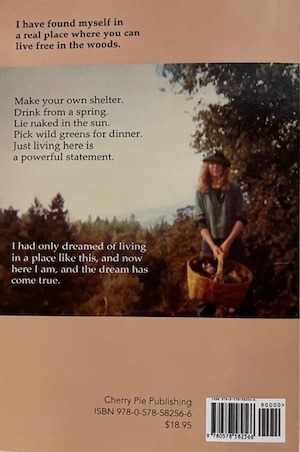 |
 Laura Blatt’s writing has appeared in Lilith, California Quarterly, The Poet, Redwood Writers anthologies and other publications. Now retired, she has worked as a website writer and a publishing company manager. Her poetry collection, Memories Lost and Found, will be released by Kelsay Books this fall.
 Sharon Brandon is a Life & Transformation coach, writer, artist, virtual assistant, and mother. She is from Virginia and living in North Carolina. When Sharon is not working, she enjoys reading and creating.
 Celestine Candida is a retired college professor who taught English composition for fifteen years at a community college in Whittier, CA. She has had short stories and essays published, and self-published a romance novella. Before teaching at the college level, she worked in the newspaper business.
 Brit Samantha Coomber has travelled extensively across the globe and since 1998 has been a full-time travel writer and editor. After 19 years based in Southeast Asia as a freelance writer, she now resides in Sydney, Australia. She’s been published in countless publications and is the author of two guidebooks.
 Suzanna C. de Baca is a native Iowan, proud Latina, advisor, teacher, author, and artist. She is the recipient of the Derick Burleson Poetry Award, Fox Tails Art of Deception Prize, Lyrical Iowa’s Grant Wood Poetry Award, and has been nominated twice for a Pushcart Prize. She is the author of You Were Never Lost: Poems from the Tallgrass Prairie.
 Janice Dilbeck is a life and career coach supporting a mature female client base struggling with ageism and sexism in the workplace. For 10 years, her practice, Socially Secure Coaching, helped women over 55 find new purpose and priority after traumatic displacement. She is now also a writer of fiction, nonfiction, essays, and short stories.
 Terri Glass is a writer, of essays, poetry, and haiku. Her work has appeared in Persimmon Tree, Eastern Iowa Review, Fourth River, About Place, Jackdaw Review, and many anthologies. Her most recent books are Being Animal and a Bridge Between Worlds from Kelsay Books. See
  Mati Gomoll is the author of Caye to Success. She was born in Belize, but lived in the U.S. most of her adult life. After a teaching career in Belize and in Michigan, Mati moved to Florida. She loves writing, languages, art, volunteering, and helping seniors.
 Enid Jones is a retired professor who taught higher education administration for over 30 years. Upon retirement she began to write and publish short stories and articles on various topics using her experience in research to make her writing enjoyable. Her stories reflect her international view of the world.
 Patricia McKowen Kane holds a master’s degree in creative nonfiction from Southern New Hampshire University. A freelance writer for decades, she has worked with clients from Google to Taco Bell, and numerous small businesses. She has four children and three grandchildren, and lives with two Boston terriers in California.
 Sandy S. Lish is a retired educator who draws inspiration from the quiet, ordinary moments of daily life. Her work has appeared in Stories of Life, Guideposts, TEACH Magazine, and other publications. She lives in New Hampshire with her husband, Andy, and is a proud savta to three grandsons.
 Marge MacKeith began writing poetry at age 60. As with most things she does, she embraced it wholeheartedly. She was introduced to poetry through her Mindful-Self Compassion practice. Other late-adopted passions include powerlifting and meditation. Her poetry focuses on healing, self-exploration and emotional growth.
 Beth MacLeod moved from rural Ohio to coastal Maine in 1974. In 1978 she drove her VW bug to San Francisco, her heart home. She thanks Natalie Green and Greacian Goeke for inviting her into the worlds of improv, dance, music, and now, clown.
 Born in post-war London, Carol Middleton migrated to Australia at the age of forty as a freelance journalist and budding bass guitarist. She now writes stories and memoir, reviews theatre and music performances, and has taken up the cello after thirty-five years’ abstinence.
 Ellen K. Reichman, M.Ed., former teacher and counselor, native New Yorker, resides in the Pacific Northwest. She is a lover of people, coffee, reading, writing, walking, poodles. Follow her at
  Barbara A. Rouillard is an award-winning writer with over 150 publishing credits. Before retiring in 2015, Ms. Rouillard was a public high school special education teacher for over 32 years. Politically active in her community, she is also fluent in French. She lives with her husband William in Springfield, Massachusetts.
 Throughout her life, Norie Sanchez’s creative mind has explored multiple arts and areas of interest. She is a watercolor artist, teacher, reader, quilter, linguist, and wanderer. She has lived in multiple U.S. cities and in Argentina, and has traveled to more than 43 countries and all seven continents, including Antarctica.
 After a career teaching and counseling young students, Stephanie Shafran joined a vibrant writing community in western MA. Her poetry, creative nonfiction, and flash fiction and nonfiction appear in such journals as Earth’s Daughters, Slant, Persimmon Tree, The Bluebird Word, The Sun, and anthologies, including Ophelia’s Mom. She published the chapbook Awakening in 2020.
 Susan Anthony-Tolbert is a Professor Emeritus (Psychology) of Gallaudet University. She always played and composed music. She embarked on a solo harp career with numerous recitals. Her recordings (classical, jazz, Celtic harp solos) sell nationally and internationally. In addition she has published poetry, novels, and history books.
 Lisa Trudel, a retired career coach and resume writer, worked for 35+ years in the educational and nonprofit sectors in Toronto, Ontario. Now almost 70 years old, she has returned to her original passion of creative writing. During the past year, she discovered the fun in writing flash fiction and flash memoir.
 Kate Peper is a signature member of the California Watercolor Association. She has shown her work locally and nationally, and was awarded the Barbara McQuaid Award for Artistic Creativity at the Marin County Fair in 2024. Her work has been published in Rattle, Nostos, Phoebe,and the Adroit Journal. Her website is:
  Linda Barrett Osborne is the author of six books on American history for middle school/young adults, including Guardians of Liberty: Freedom of the Press and the Nature of News and Who’s Got Mail: The History of Mail in America (all published by Abrams). Her adult nonfiction books include Explorers, Emigrants, Citizens: A Visual History of the Italian American Experience (Library of Congress/Anniversary Books). She was a senior writer-editor in the Publishing Office of the Library of Congress for fifteen years.