

Listen to this article. [18:57]
She sat in her pristine kitchen, reflected on her life, and wondered how things had turned out this way. She took a deep breath and gave herself rare permission to open the vault in which she’d interred the remains of her relationship with Boot’s perfect change-of-life son, Charlie. It seemed both a lifetime ago and yesterday. Her breath quickened at the thought.
Brenda remembered Charlie’s warm, sparkling eyes and the shy grin that weakened her knees. How she trembled when his lips first touched hers. How she moaned when teenage passion overcame resolve. She knew they would last forever.
But Boot, determined to keep them apart, sent Charlie off to the University of Texas in 1974, and Brenda hadn’t seen him since. She had sobbed for days after he left and stewed in toxic heartache for months.
That was about the time Little Lloyd asked her out. He offered her stability, roots. They married the week after she graduated high school. Their decade-long marriage had become a boring habit sprinkled with perfunctory sex every few months. Now she remembered Charlie’s touch and tingled with thoughts that she was pretty sure were sinful. A chill went through her and her throat tightened as she realized Charlie would be coming to town. In fact, he might already be here.
It’s hard to hide in a town the size of Escondido Springs, but Brenda managed to avoid Charlie and still fulfill her church-lady obligations. She baked her casserole in a disposable pan and happily handed it over to someone else who delivered it to the family’s house. She came up with a plausible excuse to avoid the funeral and stayed home all week.
Little Lloyd and Ellie left for the livestock auction early Saturday morning. Hours later, Brenda sipped her coffee in the empty house and stared into space, her head filled with concern for her daughter. The girl was good-natured and bright but a pint-sized version of her dad, chunky with strawberry blonde hair and freckles. Ellie’s looks were not going to get her far in life. Then Brenda’s thoughts drifted to Charlie. He had most certainly left town by now, and she wondered what it would’ve been like to see him.
“No use crying over spilt milk,” she said aloud to no one. She found a sheet of paper, prepared a lengthy To-Do list, and headed out the door.
She was rotating the small knob on the post office box when she heard her name. There was no mistaking his voice. She paused, swallowed hard, and turned. He was a few pounds heavier, with a Tom Selleck mustache, but his eyes still sparkled, and the timid grin was still there. Her mind’s eye could see his hand extended, holding a red rose from his mother’s yard. Her breath shook and she couldn’t think.
White polo shirt. Khaki shorts. Flip-flops. No hat, no boots, no beer gut. His top two buttons were unbuttoned, and chest hair peeked out. She studied his arms, strong and tan, and the outline of his chest through his shirt. His muscled legs that once entangled hers. He looked directly into her eyes, and her stomach fluttered.
They hugged—a brief side-hug like acquaintances who hardly knew each other. He smelled freshly showered. She smoothed her hair and, mindful of peeling nail polish, hid her hand in her jeans pocket. “I’m sorry about your mother.”
“Thank you,” he said. “She had a good life.”
Her mouth was dry. “I thought you’d be gone by now,” fell out of her mouth. She felt her face flush and tried to regroup by asking, “Where are you living?” Even though she knew he was in Dallas.
“Dallas,” he said. “Need to hang around a bit. Fix up the house. Get it ready to sell.” An awkward silence hung between them. His eyes searched hers. “Well, I need stamps so . . .” He paused. “You look great.” His eyes went to the floor and a red splotch crept up his neck. “Anyway, good seeing you.”
“Great seeing you too,” she said.
He headed toward the counter; she withdrew envelopes from the post office box, moved to the big trash can, and sorted through the mail. Great. He’d said “good” and she’d said “great.” Junk. Junk. Bill. She wondered if she had gone overboard with “great,” and chastised herself for not saying “good” like he did. Someone else’s mail mistakenly placed in her box. She turned toward the counter and saw Charlie head out the door.
After all these years, just a little chit-chat in the post office, and he was gone. She handed an envelope to the man at the counter—“Wrong box”—then walked to her car and placed her hand on the door handle.
“Hey,” he appeared beside her. “You want to come over for coffee?”
Brenda had lived her carefully arranged life for a decade, following all her neighbors’ rigid, unspoken rules. She was a dutiful wife in a beige marriage. Now, vivid technicolor stood before her in the post office parking lot. She knew it was a bad idea but heard herself say, “Sure.”
She left her car in the parking lot and walked the few blocks to Charlie’s childhood home, hoping that the absence of her car at his place might curtail gossip.
She stood outside and took it all in. The formerly pristine house was a shell of its previous self. Dirty white paint peeled from the snaggle-toothed picket fence. Weeds invaded the cracked sidewalk.
She tapped on the screen door. From inside, Charlie’s voice called, “Come on in. I’m in the kitchen.”
Brenda’s stomach knotted. Good Respectable Women don’t do things like this. She considered leaving, but her heart’s longing pushed her forward. She opened the squeaky screen door and walked in.
The living room was a testament to the absence of life. Stale air smelled of urine and Pine-Sol. A hospital bed stripped bare filled the center of the room. Proof of life’s last whispers—pill bottles, lotions, packages of adult diapers—sat on an end table. An oxygen machine stood in front of an old upright piano.
But it was still the same room she had stood in when she paid Boot a visit 11 years earlier. Doilies still held Hummel figurines hostage. Drapes once considered high quality, drooped from their rods. The couch was a little more faded and covered in dusty plastic. Brenda Butler Watkins’ past had circled back and was hitting her in the face.
“Coffee’s ready. How do you take it?” He stood in the kitchen door.
“Black with a little fake sweetener, if you’ve got it.”
He filled her mug, placed it on the red Formica table next to a stack of thank you notes, then turned and dug through a drawer. She watched him move around the kitchen. He looked comfortable there, and she hoped that meant there was no woman in his life. God, he’s gorgeous. She could barely breathe.
“Ah, here it is,” he said. He handed her a pink packet of Sweet ‘N’ Low and a spoon. His hand lightly brushed hers, and she wondered if he noticed.
His lids dropped as he sipped his coffee. “Tell me about your life. How have you spent the last ten years?”
“Not much to tell, really. I married Little Lloyd. We have a daughter, Eleanor. We call her Ellie. She’s nine. Smart, sweet kid. Gets it from her dad.”
“And her mom,” Charlie said.
Her heart was in her throat. She averted her eyes and sipped her coffee. “What about you? Wife? Kids?” She tried to sound like she didn’t already know the answers.
“Neither. Married to my work, I guess. I do estate planning. Draft wills and trusts, advance directives, that sort of thing.”
“Really. Well, I do PTA, 4-H, that sort of thing.”
Their eyes met across the kitchen table for a solid beat, then he cracked a smile. He reached across the table and placed his hand on top of hers. Smooth. Warm. It felt like it belonged there. Her stomach fluttered.
“You could always put me in my place. As soon as I get a little bit uppity,” he snapped his fingers, “bam!”
Warmth bubbled up in her chest, and her heart felt light for the first time in years. She turned her hand over in his. “How are you really doing, Charlie?”
His gaze met hers. “Honestly, I’m relieved. Maybe that’s terrible, but she was bedridden for years.” He paused. “Ya know, it was odd. A few hours before she died, she opened her eyes and looked completely lucid. But she started talking gibberish. She thought it was years ago. I think she thought I was a baby. Who knows? She fell asleep and that was it.”
An uncomfortable quiet crowded the room. Her stomach tightened and she fidgeted with her wedding ring.
“Listen, I need to go,” she said as she stood. “Thanks for the coff—”
There was a knock at the door. Their eyes met.
He mouthed, “I’ll get rid of them.”
Brenda heard the front door open and Charlie say, “Hi, Mary Claire. How are you?”
The local paper came out once a week, but all the real news came from Mary Claire, Town Gossip Extraordinaire. Brenda grimaced and put her head in her hands.
“Fine, Charlie. Just stopped by to get my casserole dish. Do you have company? I thought I heard voices.” Mary Claire had stepped into the living room and was fishing for intel. “Don’t want to interrupt,” she said in her saccharine tone.
Brenda stood perfectly still and silently scolded herself for being there. Her heart pounded.
“No, that was just the radio.” Charlie returned to the kitchen, grabbed the dish from the counter, glanced at Brenda, and headed back to Mary Claire. Brenda heard him say, “Here ya go. Thanks so much.”
“You’re certainly welcome.” Mary Claire droned on about what a good woman Boot was, why the hospital bed was still there, how Boot had tried to teach her piano, how terrified she was during her one-and-only recital (“Cricket and the Bumblebee,” my gracious), how lovely the service was. Finally, “Do you have any other dishes I can take? I’ll be glad to return a few.”
“No thanks. Listen, I was just about to hop in the shower so …”
An obvious lie, Brenda rolled her eyes.
“Of course,” Mary Claire said. “I’ll get out of your hair.”
“Bye, now. Thanks for everything!”
Brenda heard the front door close and exhaled. “Holy crap!” she said when Charlie reappeared. “That’s all we need is her finding us together.”
"Well, she’s gone now,” he said, exhaling with relief. He paused for a moment, then said, “Come here. I want to show you something.”
He took her hand and led her through the living room, then down a hallway lined with photographs that chronicled his life. A closed door loomed before them. She could barely breathe.
Good Wives don’t do this sort of thing. A Respectable Woman would leave. He opened the door and she walked through.
Twin beds with blue bedspreads, probably 20 years old. The one closest to the door had been slept in, the other had not. Trophies. Track medals. A Charlie’s Angels poster, brittle and curled at the corners, was tacked to the ceiling above his bed.
She remembered vividly how her mother had scoffed, “Boys like him don’t marry girls like you.” Brenda hadn’t asked what her mother meant; she knew. Girls who live in rented mobile homes don’t marry college boys. Girls who follow the boom and bust of the oil field from one pitiful little town to the next. Girls who go to nine schools in 11 years. Girls who long for something better, for roots and home and stability. For something not dirty. Girls like Brenda Butler don’t marry boys like Charlie Powell.
“Over here,” he said.
They stood before his bookshelf. Half a dozen Tarzan books, Charlie and the Chocolate Factory, The Emperor’s New Clothes. She chuckled. A set of four Escondido Springs High School yearbooks.
They sat on the unslept-in bed with the 1973-74 Escondido Springs yearbook open to the faculty section. He didn’t reach for her. Her heart sank.
“Oh God. Mrs. Keller.” Charlie pointed to a picture. “She fell asleep in class behind her Reader’s Digest.”
She hadn’t thought about Mrs. Keller in years. Now she had a quick flashback to the teacher asking her if she was going to college.
He turned the page to one covered with a collage of candid photos—and at its center, a photo of Brenda and Charlie. Her eyelids dropped and her mouth went dry. He took her hand, and they silently sat with their past.
“I loved you, Brenda.” His voice was barely above a whisper.
She wiped a tear off her cheek. “You never came home.”
“I came.” He hesitated. “I’d hide at the house for a night or two, then head out again.”
Her heart fell. “You didn’t want to see me?”
He looked away then nervously back. “I was afraid to see you. I got swept up in Austin. By the time I realized what I’d lost, you were married.”
Her eyes studied his. “I’ve been scared of seeing you too.” Remembering the sweat that had dripped from their naked bodies, her breathing was rapid and shallow. He leaned in close, his breath warm against her hair. “God, I’ve missed you,” he whispered. His lips touched hers, and for a moment she was seventeen again—heart racing, knees weak—and her soul came back to life. His hand lingered at her cheek, then slid to her shoulder and drew her closer.
Her pulse pounded in her ears. He ran his fingers through her hair. Kissed her neck. Her body begged for what her conscience banned. He unbuttoned her blouse, lightly touched her breast. She tasted the sweetness of what might have been—and what could never be. “Stop,” she said.
She stood, trembling. “We can’t. God help me, we can’t.” Her fingers fumbled as she buttoned her blouse. “I’m married,” she said. “To a good man. We have a child. A smart, sweet, innocent child.” She started to say more but the rest stuck in her throat.
He took her hand. “Don’t leave, Brenda. Please. We can figure it out.”
Light had given way to darkness, and streetlights cast a soft halo over the now-empty parking lot. Brenda sat in her car and thought about the figurines imprisoned by doilies back at Charlie’s mother’s house. She thought about coyotes, how they will chew their own leg off to get out of a trap, and she wished it were that simple.
“Mrs. Keller,” she whispered. Mrs. Keller who fell asleep in class. Mrs. Keller who asked if she was going to college. She might as well have asked if Brenda had considered traveling to the moon. Had Mrs. Keller seen something in her that she hadn’t seen in herself? No matter. If there ever were options, they were long gone now. Now, she was stuck somewhere between forward and back, and she didn’t even know which one was which. She laid her head on the steering wheel and sobbed.
A wave of rage hit her at the thought of all the grown-up decisions she had made when she was still a kid. Her pulse surged as she thought of the other baby. Just a blob of cells, really. Boot had promised to take the secret to her grave and she did. Barely. Now no one would know.
Brenda considered all her wrong turns, every time she went left when she should’ve gone right. She hadn’t escaped Escondido when she had the chance. She married a good man she didn’t love and immediately got pregnant.
Ellie.
A determined insight filled her body. She took a deep breath and started the car.
Monday morning, Brenda drove by Boot’s house. A homemade sign stood in the front yard: For Sale As Is. Charlie’s car was gone. Sunflowers in a nearby vacant lot waved in the breeze as she turned toward the elementary school.
“You went to college?” Brenda asked the fourth-grade teacher.
“Yes.”
“Good. My Ellie’s a smart girl. What do we need to do to get her there?”
Brenda locked her memories back in her private vault and turned toward the only future that mattered.
 Annunciations explores the frame that art—and life—erects around women, investigating notions of self-determination and consent in a woman’s life.
“In this astounding book, the reader is led into and out of scenes that consider art, power, gender dynamics and how expectation can be upended. The female figures are aware of how they are needed — and used — and what they must do to reclaim agency.” ——Elline Lipkin, author Girl in a Forest
“Buffy Shutt’s Annunciations examines the fraught place of women in art history alongside those striving for agency in society at large, all while returning to representations of the Annunciation, a moment of intimate tension between the human and the divine, implicating the reader in a web of complicity, desire, and violation.” —–Luiza Flynn-Goodlet, author most recently of Mud in Our Mouths
“Through the lens of exploring annunciation artwork, this collection investigates and then transfigures the violence women face when agency is denied or stolen from them. These poems provide a much-needed reclamation of the narrative around the annunciation and is a delight to read from start to finish.” —-Katie Richards, author of Apple Mind.
Available from Rockwood Press.
Annunciations explores the frame that art—and life—erects around women, investigating notions of self-determination and consent in a woman’s life.
“In this astounding book, the reader is led into and out of scenes that consider art, power, gender dynamics and how expectation can be upended. The female figures are aware of how they are needed — and used — and what they must do to reclaim agency.” ——Elline Lipkin, author Girl in a Forest
“Buffy Shutt’s Annunciations examines the fraught place of women in art history alongside those striving for agency in society at large, all while returning to representations of the Annunciation, a moment of intimate tension between the human and the divine, implicating the reader in a web of complicity, desire, and violation.” —–Luiza Flynn-Goodlet, author most recently of Mud in Our Mouths
“Through the lens of exploring annunciation artwork, this collection investigates and then transfigures the violence women face when agency is denied or stolen from them. These poems provide a much-needed reclamation of the narrative around the annunciation and is a delight to read from start to finish.” —-Katie Richards, author of Apple Mind.
Available from Rockwood Press.
 Nancy K. Martin is the award-winning author of two short stories, “Escondido” and “Thin Places.” Her writing is influenced by her experiences growing up in rural south Texas and as a university professor. She currently lives in San Antonio.
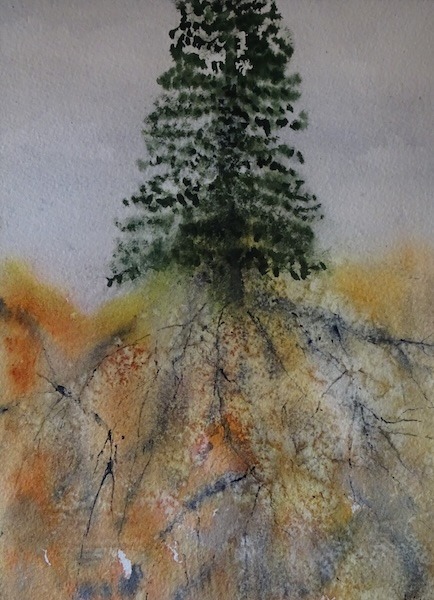
 Berta Morgan lives on the Central Oregon coast with her partner and her beloved cat Gracie. Her work focuses on forests and, of course, the Pacific Ocean. Currently, she is working on a series of paintings of Mother Trees left in clear-cutting operations.